Pigsqueak, Early-Blooming Evergreen Ground Cover
Baby’s Breath, Lamb’s Ear, Goat’s Beard…. Plants’ common names often give great clues about what those plants are like. Pigsqueak… well, maybe not so much. Or, maybe….
Pigsqueak, more eloquently called by its botanical name Bergenia cordifolia, is a low-growing plant, perennial in zones 4-9, with foliage that is smooth and leathery. It is said that the name Pigsqueak comes from the sound these leaves might make when rubbed together… a stretch, but I get it.
Pigsqueak has visible, slightly stocky (meaning, these are not wire-thin) and succulent stems that display flower sprays in bright and happy pinks, rose tones, lavender-pink, or white. Those strong and visible stems surely remind me of little piggy tails, despite the fact that the stems stand straight, no curly squiggles. I suppose, where there’s a pig there’s a squeak. The connection between common name and plant characteristics is not so clear as it is with, as an example, Goat’s Beard… but connections can be made. And the name Pigsqueak certainly is cute.
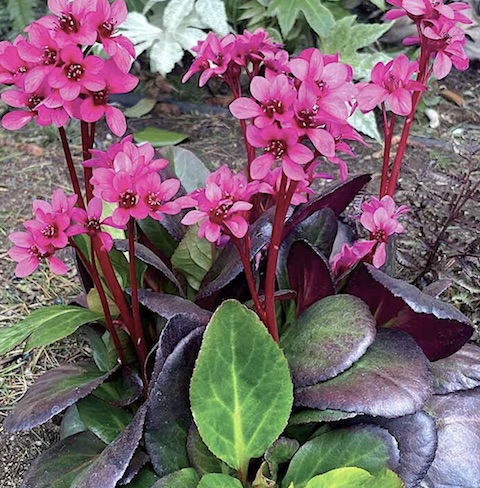
Pigsqueak has leaves that are rounded and pile atop one another, mounding with ease. In this loosely clumped form, the leaves stay within bounds as they sit beneath the flowers which appear suspended above them.
The leaves of Pigsqueak are heart-shaped near the base of the plant. Higher up, they remind me of Ajuga leaves, which have more of a spoon shape. With some Bergenia cordifolia varieties, the coloration of foliage changes with changes in temperature, making the top leaves seem even more like some Ajuga varieties. Just as we see deep and dark foliage on Ajuga ‘Chocolate Chip’, for example, the foliage of ‘Early Brilliance Magenta’ Pigsqueak becomes burgundy-black in cold weather, turning green as the world warms up. I see similarities there, across the foliage, and I know these plants would make fine garden mates, with similar light, water, and soil-type needs.
In zones 4-9, many/most gardeners will find that the foliage stays evergreen (or burgundy-black). I know some gardeners in very cold weather zones, so their plants may behave differently, with a die-back and return. But for most, the leaves will remain all year.
In terms of light, Pigsqueak likes sun or partial shade (at least some prolonged block of time in the shade each day). With little care, its clustered flowers show well, and they last…. I mean, they last for weeks. Its polite spreading nature helps small mounds grow larger over time, covering ground just enough—no overtaking a garden bed, no invasive tendency. This is just a nice plant that can cover ground effectively, offering flowers and foliage interest.
Back to names, the ‘Early Brilliance’ name of the Pigsqueak series noted here seems clearly to come from Bergenia cordifolia’s early bloom time. Flower sprays become visible very early on, long before other flowering plants have begun to do much of anything. In some areas, this may mean seeing flowers in late February or early March. Elsewhere, April-May blooms are more likely. But we are talking early. I look for this kind of performance in a plant, as early and long-lasting flowers are very desirable to me. Who wants to start the season late? Who wants flowers that fade quickly? With Pigsqueak, there’s little waiting, and once bloomed, the flowers like to stick around for a while.
I might have forced connections between the common name of Pigsqueak and the plant’s attributes. I see the connections, but again, I see them better between, say, the woolly soft foliage of Lamb’s Ear and the common name for the plant that possesses it. Regardless, considering my desire to add early, vibrant, long-lasting color to the garden, and also benefit from being able to look at pretty foliage all year long, I feel as though I should go “to market,” and “this little piggy [should go] home” with me.
Comments
{{ errors.first("comment") }}