Stokes' Aster
At this point in the year, I live in fear of seeing a pumpkin or orange and burgundy Mums. Those are welcome sights later on, but as a summer-lover, I can’t bear to see those harbingers of a new season—a season which, for now, will remain unnamed. But Stokes’ Aster is a different story.
Granted, pumpkins and Mums aren’t ready yet, so my fear is somewhat unfounded. Still, they welcome the cool weather and different pleasures, and right now, I am still in summer mode. (You are too, right?) I want more days of bare feet and heatwaves, where my biggest problem is melting ice cream. Nice as they are, Asters would typically remind me of what I don’t want to admit: The days are getting shorter, the breezes are a bit cooler… summer won’t last forever.
But back to Asters: New England Asters are a go-to for adding rich purple or paler lavender color to gardens that get restocked with yellow, orange, and red Mums at a certain time in the year. New England Asters’ color is shared by way of daisy-like flowers… simple and pretty, with petals radiating out from the center. They last until the true cold sets in, and then we are off to new interests, new sights. Pretty plants but, please, no talk of New England Asters yet.
Stokes’ Aster, though often confused with the New England beauties when plants are being called by their common names, are a different plant. The botanical name for Stokes’ Aster is Stokesia laevis, while New England Aster is Symphyotrichum novae-angliae… different plants. Stokes’ Aster blooms from May through a good stretch of the summer. These blooms remind me of Cornflowers in many ways, but they’re bigger, growing up to four inches across. The blooms have fringed outer petals and interestingly textured centers with lavender or whatever the base color is interspersed with white; the centers have an appealing terrycloth look. To get the best mileage out of the plant’s bloom time, deadheading is helpful, but it’s not needed that frequently, as the flowers are long-lasting.
Stokes’ Aster varieties bloom in purple tones, blue, palest pink, white… even yellow. I am fond of the purples. The purples seem to light up, somehow always seeming illuminated atop an attractive base of lance-shaped green leaves.
Stokes’ Aster plants appreciate sun or partial shade, and they are very good about settling in to a variety of soils without issue. I planted three in an inhospitable part of one garden bed—rocky, with soil that was very hard to dig. I know I could have chosen a spot with better drainage, and that would have been well-advised, but my plants were fine. Now I have countless buds and blooms. Last year, upon adding Stokes’ Aster to the garden, the plants experienced a settling period which lasted about a week or so. Then the plants looked great. This year… even better. This photo, taken with the early morning sun causing the blooms to look a little rosier than they actually are (in actuality, they are pale lavender), shows the many buds that appear all at once. Stokesia laevis is an easy perennial which does not seem to need perfect conditions to look its best. Each year, its “best” seems to get better.
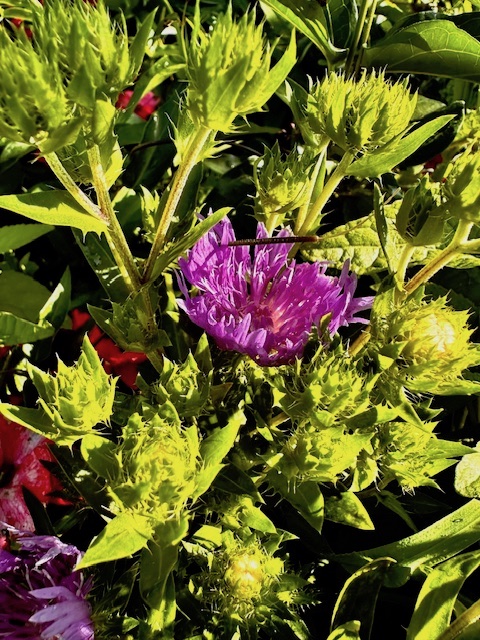
I must say that my yard is loaded with bunnies. No worries with Stokes’ Aster. And while bunnies (and, I am told, deer) do not take interest in this plant, bees seem always to be near it. It makes a great front border plant for a pollinator garden, as its flowers are attractive to pollinators, and its height and spread are about two feet across, at max. My plants have not spread that much, mainly because they are crowded by surrounding plants. However, the bees still manage to find them, and I certainly see them, looking lovely and summery… I repeat, summery.
Now, a final note about Stokes’ Aster: You’ll see the common name spelled perhaps most frequently as “Stoke’s”, and some instances don’t even venture into placing the apostrophe. But the plant was named for botanist Jonathan Stokes, and so no matter how you see it spelled, you’ll know that the plant is Stokes’ Aster (apostrophe after the final –s in the name.)
Don’t worry about the pumpkins and Mums. By the time they’re ready, we’ll be ready to see them. But for now, it’s summer, and summer is the time for Stokes’ Aster.
Comments
{{ errors.first("comment") }}