Gardeners with Allergies
Is it possible for gardeners who absolutely love gardening to be allergic to plant pollen? Yes…, from personal experience, yes.
Coming from a long line of plant lovers who’ve appeared red-eyed, runny-nosed, and generally uncomfortable in early spring and the latest part of summer, I know for sure from whence my allergies have come.
My grandmother, who would toil in the garden to the point of eradicating every bit of invasive Sumac on her property—without help, by hand, and when she was in her late 70s—was no stranger to hard work. She could bend and pull and lift… but get a little pollen in her nostril, or let it hit one of her beautiful aqua (I’m serious, aqua-blue) eyes, and she’d have to take to her bed for an afternoon, feeling the residual effects of allergies even later.
My dad (not the son of the grandmother I speak of here… I have allergies coming from both sides), who served in a war, worked hard, and had great scientific training that would enable him to puzzle through almost anything, could never figure out how to avoid “Hay Fever”. Just like the woman who would become his mother-in-law, he was taken down by pollen… made miserably stuffed up, drippy, and downright sick when he came in contact with the wrong plant, or more specifically, plants that would give up their light, airborne pollen easily.
Did each of these folks curtail their gardening? Nope. They could not resist, and when a garden chore beckoned, they rose to the call of duty, ready to risk feeling bad temporarily, in return for tending the plants they loved.
I do the same. I'm not as hard a worker as either of these lovely people. However, my nose, eyes, and head are as affected as theirs were when I come in contact with certain plant pollen, especially on the two extreme ends of summer when either new growth or end-of-season cutting, mowing, or dryness stir up pollen and cause it to go aloft.
What can be done to help the gardener who can’t avoid deadheading a plant, pruning a shrub, pulling weeds...?
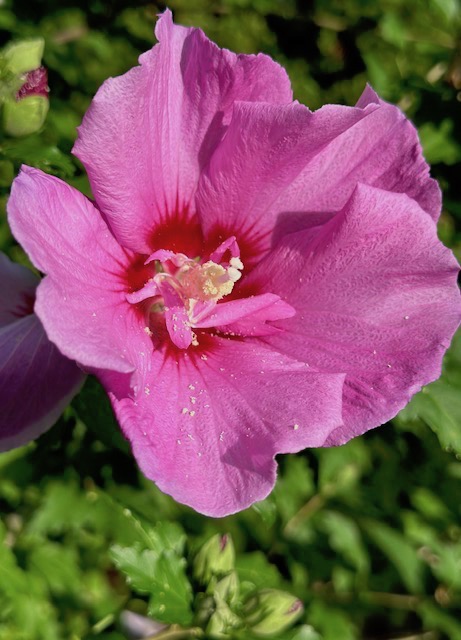
First off, know that what you might assume to be the most allergy-unfriendly plants may in fact be low-allergen ones. A plant with visible pollen—take the Hibiscus as an example—is not the culprit when it comes to making gardeners uncomfortable if they are allergic. Hibiscus’s pollen is characterized by sticky, heavy grains that don’t invade the nose. Tropical Hibiscus plants, and even the Rose of Sharon which is known for having bloom upon bloom with very visible stores of pollen, are low-allergenic. I use this as a lesson to make myself aware of the fact that I may need to look up a plant before making assumptions. Not every plant with pollen which can be seen easily will cause an allergic reaction.
Lilies with their visible stamens covered in pollen are also generally safe for those with plant allergies. When it comes to both the Hibiscus and Lily, the pollen is transported by insects and is not reliant on becoming airborne on its own to create new plants. This visible but very heavy pollen is not the culprit which causes allergy sufferers to reach for a box of tissues.
Roses sometimes have very visible pollen stores (think of the yellow centers of Rosa rugosa), while Hydrangeas do not. But both of these plants are low-allergenic—good choices for gardeners with allergies. What’s funny about this is that both are loved by pollinators. I have butterflies and bees visiting my Roses and Hydrangeas all the time. But these plants with their pollen which is so desirable to insects are safe for humans with allergies. The same goes for shade-loving Impatiens, Calibrachoas, Delosperma, known as the Ice Plants, and many other plants.
Trees are often a forgotten source of pollen—that is, until we head to our cars and find they’ve turned yellow under a fine dusting we didn’t expect to see. But fruit trees are pollinated by insects and possess the heavy pollen that will not be a bother in terms of allergies. Pine trees are the same, with heavy pollen that won’t provoke a sneeze.
Choosing plants that are less allergenic than others is a smart thing to do if you have allergies. But avoiding every plant that has the fly-through-the-air sort of pollen is completely unrealistic for most gardeners. We love plants too much and don’t want to miss out on any. We’ll suffer a little misery in order to have all the plants we desire.
So what can help?
Masks—we probably all still have them from you-know-when—can be a help during the worst days, when the pollen count is highest. Donning a mask when trimming or weeding may look a little silly—“doctor, are you in?”—but it’s worth it in the end. Weeding after a rain shower passes can also help, as steady periods of light rain can keep the plant pollen down. And finally, taking breaks to head into air conditioned spaces for brief periods of relief can be a help to those who have run into Ragweed or encountered some other allergy-unfriendly plant.
Yes, there are gardeners with allergies. They sometimes seem as though they have a bit of a head cold, though they are not contagious. Their eyes are often a little watery. They sometimes complain about Hay Fever. But they still garden. They just can’t resist. If you’re one of them, maybe it helps to know that there are plenty of others of us. We can’t resist either. We just can’t resist.
Comments
{{ errors.first("comment") }}